
Long Island’s Licensed Mold Remediation Experts: Inspection, Removal, and Prevention Under One Roof
You could say that mold loves Northeast homes. Long Island, especially, thanks to its soupy coastline humidity, decades of residential slab-foundation-construction, and below-grade finished basements, creates some of the most mold-friendly conditions in the Northeast. Mold insidiously finds its way into Long Island properties, and when left unchecked, it spreads rapidly through wall cavities, across structural framing, and into HVAC systems.
At United Water Restoration Group of Long Island, we’re the top licensed mold remediation company in Long Island, NY, serving Suffolk County and the surrounding areas. Our certified team is trained not only to remove mold but also to identify and fix the source of the problem to prevent it from coming back. We provide comprehensive mold inspections, testing, and full remediation services to keep your property safe, healthy, and, ultimately, mold-free. Call us today for a professional mold inspection and remediation plan.
Our Mold Remediation Process
Mold remediation requires expertise and precision. When not done properly, mold spores can spread throughout the property, worsening the problem and putting your health at risk. That’s why it’s critical to hire an experienced company like United Water Restoration Group of Long Island to handle the process safely and effectively.
Our mold remediation process includes:
- Mold Testing & Inspection: A thorough property inspection and mold testing to locate all areas of contamination and the source of moisture fueling it.
- Containment: Isolation of affected areas using barriers and negative air pressure to stop spores from spreading.
- Air Filtration: HEPA filters and scrubbers purify the air of mold spores and particulates, improving indoor air quality.
- Mold Removal: Specialized cleaning methods remove mold from non-porous materials, while heavily contaminated porous materials are safely removed and replaced.
- Restoration & Prevention: Repairs are made to fix water leaks or other causes of mold growth. Preventive solutions such as dehumidification, improved ventilation, and waterproofing ensure mold does not return. Final inspections and air quality testing confirm the property is safe and healthy.
Mold Remediation vs. Mold Removal: Understanding the Difference
Though the two terms are often used interchangeably, they describe very different scopes of work
Here’s what each actually involves and why the distinction matters for Long Island homeowners and businesses.
Mold Remediation
Mold remediation is a comprehensive process that goes beyond addressing the mold you can see, getting to the root of the conditions that allowed the mold to grow and fester in the first place.
Our mold remediation services in Long Island, NY include:
- Full inspection of your property, including testing the air quality across all affected areas, including hidden mold behind walls, under flooring, and above ceiling assemblies.
- Identification and correction of the moisture source fueling mold growth, whether that’s aa plumbing leak, roof intrusion, or chronic humidity levels.
- Containment of affected areas using physical barriers and negative air pressure, preventing spores from spreading to unaffected parts of the property while we handle the remediation process.
- HEPA air filtration and air scrubbing to capture airborne mold spores and improve indoor air quality throughout the property.
- Removal of mold from non-porous surfaces using specialized cleaning agents and antimicrobial treatments (like Sporicidin Disinfectant Solution or Foster 40-80 Antimicrobial Coating).
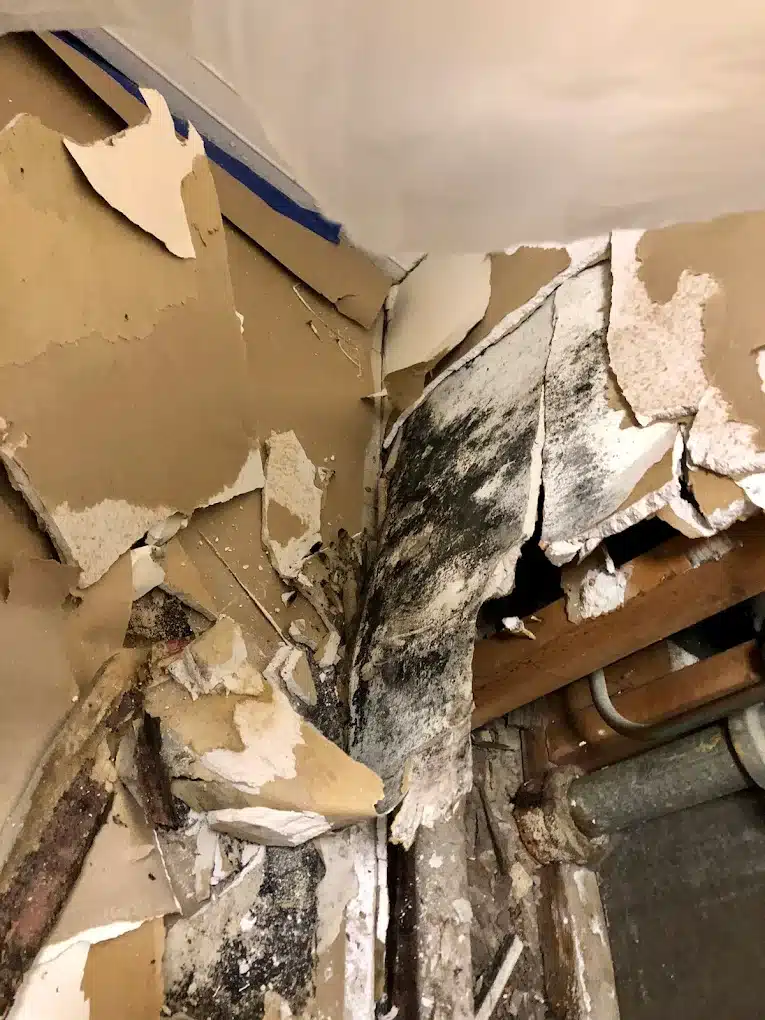
- Safe removal and disposal of heavily contaminated porous materials, like your drywall, insulation, and flooring.
- We perform preventive treatments, dehumidification recommendations, and ventilation improvements to reduce the likelihood of future mold growth
Mold Removal
Mold removal is a narrower, surface-level process that focuses specifically on the actual elimination of visible mold growth.
Mold removal in Long Island, NY, typically includes:
- Visual identification and cleaning of visible mold growth on hard, non-porous surfaces, commonly tile, glass, or sealed concrete.
- Application of surface-level antifungal or antimicrobial cleaning agents (such as Zinsser Mold Killing Primer or Vital Oxide) to eliminate surface mold colonies.
- Removal and disposal of any small affected materials that can’t be cleaned.
- Basic ventilation and drying of the affected area.
Who Pays for Mold Remediation?
Mold remediation may be covered by homeowners’ insurance if the mold results from a sudden and accidental event, such as a burst pipe or water heater leak. However, if mold develops due to neglect, like not repairing leaks or failing to maintain proper ventilation, the homeowner may be responsible for costs. Review your insurance policy for details on mold coverage.
Mold Remediation Cost
The cost of mold remediation on Long Island typically ranges from $2.50 to $20 per square foot, depending on several factors:
- Extent of Infestation: Larger mold outbreaks are more costly to address.
- Type of Mold: Certain molds require specialized removal methods.
- Location of Mold: Attics, crawl spaces, and other confined areas increase costs.
- Moisture Source: Plumbing or water damage repairs may add to expenses.
- Material Contamination: Mold affecting drywall, flooring, or insulation requires removal and replacement.
What Type of Mold Do We Work With?
No matter the type, severity, or location, United Water Restoration Group of Long Island can create a plan to eliminate mold from your property.
Common types of mold we handle include:
- Stachybotrys chartarum (Black Mold): Dark green to black, thrives in water-damaged areas, and is linked to health risks.
- Penicillium: Found on food, water-damaged materials, and indoor air; some species are allergenic.
- Aspergillus: Common indoors, can produce harmful mycotoxins in damp conditions.
- Cladosporium: Appears as dark spots, grows on carpets, walls, and textiles.
- Alternaria: Common in bathrooms and kitchens, appears as dark green or brown spots, and is allergenic.
Mold Removal, Remediation, and Inspection Considerations for Long Island Homeowners
In Oceanside spaces, mold tends to crop up in a lot of different spots, in a lot of different ways.
And that variety of mold problems requires a variety of solutions to tackle, and specific considerations that Long Island homeowners should keep in mind.
Mold Remediation Considerations
Moisture and mold tend to go hand in hand, with the former leading to the latter. Remediation is the process that tackles that moisture at its source.
Some Long Island-specific things that homeowners should keep in mind when it comes to remediation include:
- Surge flooding in South Shore crawl spaces and slab foundations: Nor’easters and hurricanes bring in contaminated Category 3 water that leads to dark/black mold growth.
- Vapor barrier problems in mid-century Cape Cods: The plastic or foil vapor barriers in Levittown-style properties allow moisture to seep into framing and insulation as they age, making them prime spots for mold growth.
- Attic sheathing on the North Shore: Heavy winter snow and roof leaks trap moisture against attic sheathing, making it a prime spot for targeted remediation.
- HVAC ductwork in humid coastal summers: Your ductwork, the flexible metal tubing that shunts heated or cooled air around your home, can actually be a prime spot for mold to secretly grow and build up. When you add in the humid sea air seen during the summer months, mold gets exactly what it wants.
Mold Inspection Considerations
Most homeowners don’t notice mold growth until it’s become a serious, dramatic issue. Why might this be? Well, mold tends to take hold of Long Island homes in the nooks and crannies out of sight.
Some of the common spots and situations where we find mold include:
- Finished basements after summer nor’easters: Drywall basements become some of mold’s go-to spots when Long Island has seen a lot of storms and rain, increasing the water table.
- Pre-purchase inspections for older properties: From the 17th-century Dutch-Colonial homesteads on to the sweeping Gilded Age estates dotting the North Shore, folks who’re looking to invest in real estate in Long Island always benefit from a pre-purchase inspection to find the potential signs of years-long moisture buildup in the hidden corners and behind walls.
- Thermal imaging in split-level homes: Long Island split-levels are great for a number of reasons, but they’re prone to water leaks from sweating pipes, pipes that are almost always out of sight. Infrared scans are the ideal way to get to the bottom of those moisture problems. That way, we can find where the moisture is happening without having to tear up your house.
- Winterized and seasonal homes: Seasonal vacation homes here in Long Island are the frequent victims of mold growth, mold that often has months and months to not just survive, but also thrive and spread.
Mold Removal Considerations
Mold removal is more of a last-resort technique, done when the mold has snaked its way into the actual building materials themselves, making them a dangerous liability.
We commonly see this happen in scenarios like:
- Cinderblock basements in Huntington and Smithtown: The telltale signs of mold in cinderblocks come from the moisture that precedes it. Homeowners tend to see that moisture in the form of white powdery mineral deposits.
- Ice dam leaks in Colonial homes: Ice dams are the frozen ridge that builds up along the edge of your roof. That thick ice tends to keep melting snow from draining off the roof. With nowhere to go, all that backed-up water can soak into your Colonial’s ceilings.
- Slab homes with aging radiant heating tubes: Mid-century Long Island homes frequently have floor-laid radiant heating tubes, heating setups that were put in place years ago and have likely started to wear down. When they do, they’ll leak, leading to mold-ridden subfloor areas that need to be removed ASAP.
- Wood paneling in unventilated basement dens: Wood-paneled basements are another common sight in a Long Island home, but another common site for mold infestation.
Frequently Asked Questions
When is mold remediation required?
Mold remediation is required when mold growth is visible, spreading, or connected to an ongoing moisture source. Without intervention, mold can expand into larger infestations and cause health risks.
How long does mold remediation take?
On average, mold remediation takes 1–5 days. For more severe infestations or large properties, the process may take several weeks to fully eliminate mold and ensure long-term protection.
Is mold remediation required by law before selling a home in New York State?
New York State doesn’t have a specific law that explicitly requires mold remediation before a home can be sold. However, New York’s Property Condition Disclosure Act does require sellers to disclose known material defects in the property, and known mold certainly counts as a material defect that must be disclosed to prospective buyers. Failing to disclose that you’ve had known cases of mold in your home (especially if you’ve had any mold remediation services in Long Island, NY, in the past ) exposes potential legal liability after the sale.
How long after a basement flood should I wait before having a mold inspection done?
The short answer is that you shouldn’t wait at all. In Long Island’s humid climate, mold begins to grow in as little as 24-48 hours after water intrudes, particularly in moisture-prone, limited-airflow basements. If your basement has flooded and you haven’t yet had professional water extraction and drying performed, your first priority should be getting a restoration team on-site immediately, nipping the mold in the bud.
Call Our Emergency Long Island Mold Remediation Specialists Today!
If you suspect or see mold in your property, it’s essential that you call United Water Restoration Group of Long Island immediately. Mold spreads quickly and can cause significant health problems as well as structural damage if ignored.
Our certified experts are available 24/7 to provide inspections, testing, and full mold remediation services in Long Island, NY, Suffolk County, and surrounding Long Island communities. With a reputation as a 4x winner of Best Restoration Company of Long Island and a proud member of the Middle Country Chamber of Commerce, we are trusted experts in mold remediation for both residential and commercial properties. Speak to us!