
UWRG of Long Island Is Oyster Bay’s Trusted Water Damage Restoration Company
Oyster Bay’s geographic breadth creates a water damage risk profile unlike any other community on Long Island. A homeowner on the waterfront near Oyster Bay Harbor faces exposure to coastal flooding and storm surge from Long Island Sound. A homeowner in Hicksville or Plainview faces the water damage risks common to Nassau County’s dense post-war suburban neighborhoods, including aging plumbing in homes built in the 1950s and 60s, galvanized steel pipes that have long since passed their serviceable life, and the foundation moisture issues that come with the area’s relatively high water table. A homeowner in Brookville or Cold Spring Hills faces the water damage dynamics associated with large-footprint estate properties on wooded, rolling terrain that manage stormwater in ways smaller suburban lots simply don’t.
That spectrum of exposure across a single municipality is what makes local expertise matter so much in Oyster Bay. United Water Restoration Group of Long Island has been serving the full breadth of Nassau and Suffolk County since 2019, and we bring the depth of experience to water damage restoration in Oyster Bay, NY, that Nassau County’s varied communities demand.
Water Damage Restoration vs. DIY Cleanup: Why It Matters in Oyster Bay
When water damage occurs in an Oyster Bay home, the instinct to act immediately and handle it personally is understandable. Here’s why that instinct (while well-intentioned) almost always leads to incomplete results, and why the gap between DIY cleanup and professional water damage restoration matters more in Oyster Bay’s older properties than in newer construction.
DIY Cleanup
DIY water damage cleanup typically involves towels, mops, box fans, and consumer-grade wet vacuums, all tools that address surface water without significantly affecting the moisture that’s already migrated into the structure. In Oyster Bay’s post-war Capes, expanded ranches, and older Colonials, that migration happens quickly and goes deep.
Here’s what DIY cleanup misses:
- Moisture wicked into original subfloor assemblies and floor cavities within minutes of the intrusion event
- Water that has migrated behind original plaster wall systems and saturated decades-old insulation
- Hidden moisture in wall cavities that consumer fans cannot reach, even when surfaces appear dry
- The mold colonization that begins in as little as 24 to 48 hours in Oyster Bay’s ambient humidity conditions, when cavities remain wet after a surface-level cleanup
- No moisture metering or thermal imaging to confirm whether drying is actually complete
Professional Water Damage Restoration
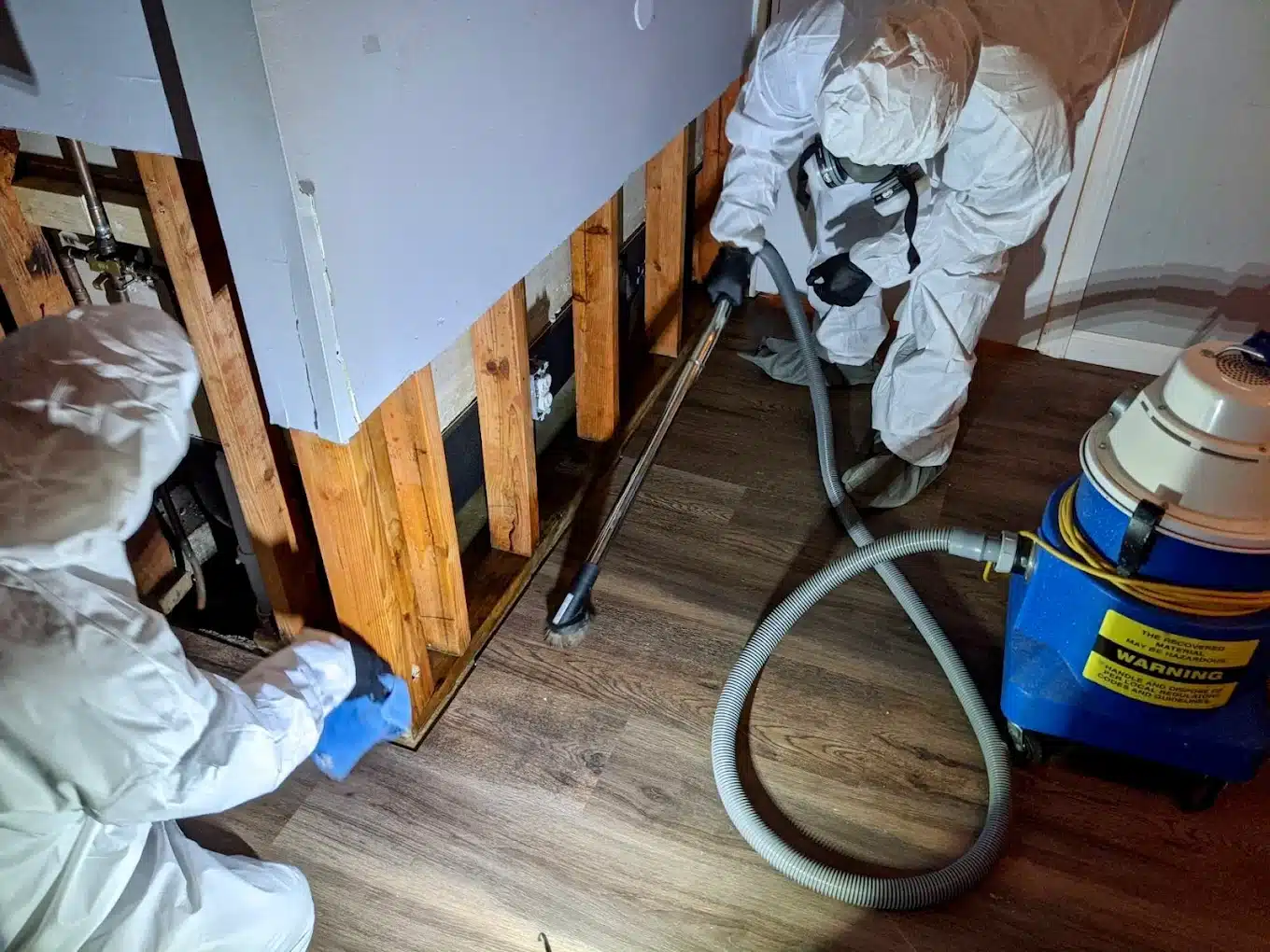
Professional water damage restoration addresses the complete scope of what water actually does to a structure, not just what’s visible at the surface.
Our professional restoration process includes:
- Thermal imaging and calibrated moisture metering to map all moisture presence, including cavities and assemblies with no visible surface indication of saturation
- Industrial extraction equipment that removes water from structural assemblies at depths that consumer equipment cannot reach
- Industrial air movers and high-capacity dehumidifiers that dry the property from the inside out
- Daily moisture readings are tracked against established drying targets rather than relying on surface appearance
- Informed material decisions based on experience with how original plaster, hardwood flooring, galvanized plumbing systems, and decades-old insulation respond to moisture in Oyster Bay’s older construction
- Complete documentation throughout for insurance claim support
How Oyster Bay’s Wetlands and Tidal Zones Affect Local Groundwater and Flood Patterns
Oyster Bay’s natural geography makes water a defining feature of the landscape in ways that have direct implications for property owners throughout the township.
Key factors shaping local groundwater and flood patterns include:
- Active tidal exchange zones along Oyster Bay Harbor and the waterways connecting it to Long Island Sound create groundwater levels throughout the North Shore portion of the town that fluctuate with tidal activity and seasonal rainfall rather than remaining stable
- Tidal wetlands extending inland along creek corridors absorb and buffer storm surge and heavy rainfall events, but they also mean that a significant portion of Oyster Bay’s residential land sits adjacent to areas where the water table is directly influenced by tidal conditions
- Higher and more variable groundwater table near tidal wetland corridors creates hydrostatic pressure on foundation walls that changes with rainfall accumulation and tidal conditions, making basement seepage and foundation moisture issues more persistent than in inland Nassau County communities
- Heavily wooded terrain creates concentrated stormwater runoff patterns during heavy rain events, channeling water through residential neighborhoods and increasing the moisture load on foundations and below-grade spaces throughout the spring storm season
- Tidal flooding events during nor’easters push water through low-lying streets and into waterfront and near-waterfront properties at ground level along the Oyster Bay Harbor corridor, introducing saltwater contamination and corrosion concerns that require more extensive remediation than standard freshwater intrusion events
Frequently Asked Questions
Does the FEMA Substantial Damage rule affect water damage repairs in Oyster Bay’s flood zones?
Yes, and many homeowners don’t discover this until they’re already mid-project. The FEMA Substantial Damage rule states that if a structure in a designated flood zone sustains damage where restoration costs equal or exceed 50 percent of the structure’s pre-damage market value, the property must be brought into full compliance with current floodplain management regulations before repairs can be completed.
For Oyster Bay flood zone properties, this can mean elevating the structure to Base Flood Elevation, a major undertaking well beyond the original restoration scope. The rule also applies cumulatively in some municipalities, meaning multiple smaller repair projects over time can collectively trigger the threshold.
Why does the Town of Oyster Bay have two such different flood risk profiles?
Because Oyster Bay is the only town in Nassau County that spans the full width of Long Island, and its North Shore and South Shore face completely different bodies of water with completely different flood dynamics.
North Shore communities along Oyster Bay Harbor and Cold Spring Harbor face Long Island Sound, where nor’easter-driven storm surge and sustained wave action over 24 to 48 hours are the primary flood mechanisms. South Shore communities face Great South Bay and the barrier island system, where major storms push large volumes of bay water through inlets and across low-lying coastal areas rapidly (as Sandy demonstrated definitively in 2012).
Inland communities, including Hicksville, Plainview, Woodbury, and Bethpage, face neither coastal scenario directly, with water damage risk driven primarily by aging infrastructure, high water table conditions, and stormwater management challenges.
Schedule Your Water Damage Restoration Services in Oyster Bay, NY Today
Whether your Oyster Bay property is a waterfront colonial on the harbor, a post-war Cape in Syosset, or a large estate in Brookville, UWRG of Long Island provides the emergency water damage restoration in Oyster Bay, NY that your property and its unique risk profile demand.
We’re available 24 hours a day, seven days a week, with free visual assessments, direct insurance billing, and a certified team that knows this town and the water damage challenges it presents.