
Huntington’s Trusted Water Damage Company Serving Communities From Cold Spring Harbor to Melville
Huntington’s proximity to Long Island Sound and the tidal waterways of Huntington Bay and Centerport Harbor creates direct coastal flood exposure for properties along the North Shore waterfront, where nor’easter-driven storm surge and coastal flooding are recurring seasonal realities. Inland from the waterfront, Huntington’s heavily wooded terrain creates its own set of water damage dynamics, with hillside properties managing surface runoff that concentrates in low-lying residential streets, and the deep tree canopy contributing to the chronic shade and moisture conditions that accelerate mold development in older homes throughout the township.
United Water Restoration Group of Long Island is the water damage company in Huntington, NY, with IICRC-certified technicians who understand the area. As the 4x winner of Best Restoration Company of Long Island, with an A+ BBB rating and a track record of fast response across Nassau and Suffolk Counties since 2019, we deliver the professional standard that Huntington’s high-value properties demand. We respond 24/7, offer free visual assessments, and bill insurance directly, so the process is as smooth as the restoration itself.
Our Water Damage Restoration Process
Water damage restoration in Huntington, NY, is never a single step, but rather a structured process that moves through several phases, each building on the last, to take a property from active water emergency back to fully restored condition.
Here’s what that process looks like when UWRG of Long Island responds to a Huntington property:
- Emergency Response & Source Control: Our team arrives within the hour, identifies and confirms the source of the water intrusion, and takes immediate steps to stop ongoing water entry before assessment begins
- Full Property Assessment & Moisture Mapping: Using professional moisture meters and thermal imaging equipment, we conduct a thorough walkthrough to identify all affected areas, including hidden moisture behind walls, under flooring, and above ceiling assemblies in Huntington’s older multi-story construction
- Containment of Affected Areas: Physical barriers and, where necessary, negative air pressure environments are established to prevent moisture and contaminants from migrating into unaffected areas of the property during the restoration process
- Water Extraction: Industrial submersible pumps, truck-mounted extraction units, and specialty floor extraction equipment remove standing and surface water from all affected areas, with post-extraction moisture readings taken to confirm complete removal
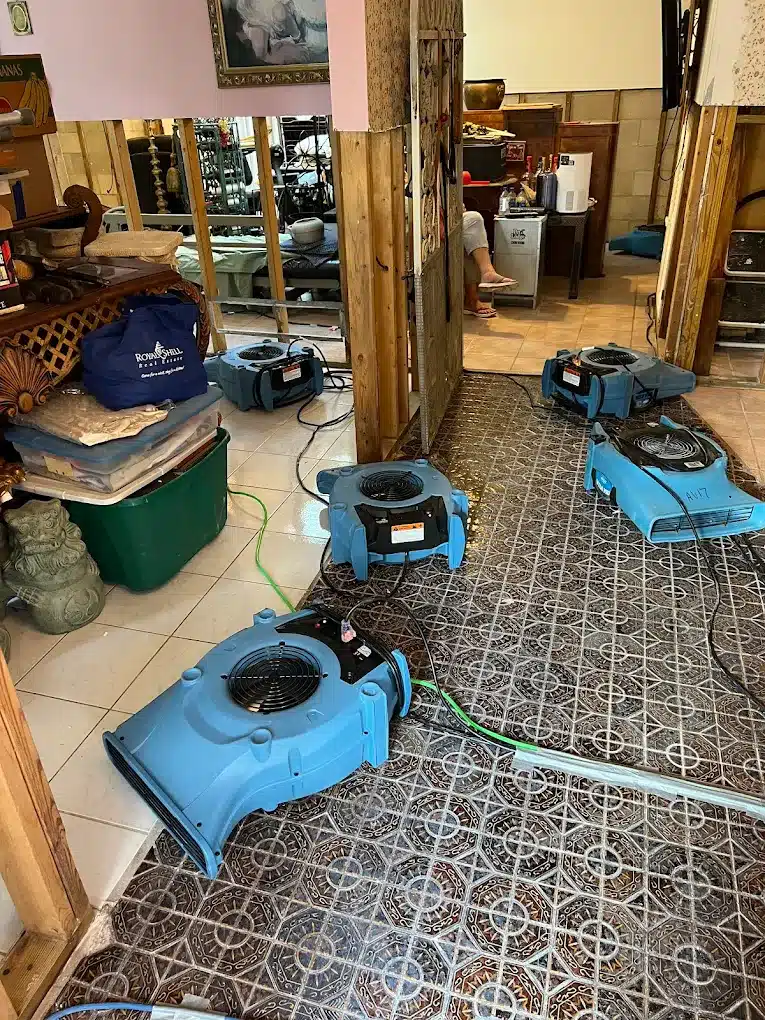
- Structural Drying & Dehumidification: Industrial air movers and high-capacity dehumidifiers are strategically placed throughout the affected areas, with daily moisture readings tracked against drying targets until all materials reach acceptable levels
- Sanitization & Antimicrobial Treatment: Once drying is confirmed, EPA-registered antimicrobial treatments are applied to all affected surfaces to eliminate bacteria, prevent mold colonization, and neutralize odors
- Material Removal & Remediation (When Required): Saturated building materials that cannot be effectively dried in place, including drywall, insulation, flooring, and, in older Huntington homes, original plaster wall sections, are carefully removed, with contaminated materials disposed of appropriately
- Reconstruction & Restoration: From drywall replacement and flooring installation to painting and structural carpentry, our team completes the rebuild to return your Huntington property to its pre-loss condition, with all permitting coordinated through the Town of Huntington Building Department
- Insurance Documentation Throughout: Every phase of the process is documented in real time, with moisture readings, photographs, and material records compiled into a complete claims package for your insurance carrier
Signs You Need Water Damage Restoration in Your Huntington Home
Water damage in Huntington’s older housing stock frequently goes undetected for longer than homeowners realize, because the signs aren’t always dramatic.
Here’s what to watch for in the Capes, Colonials, and split-levels that define much of the township’s residential character.
Musty Odors & Early Mold Growth
- Persistent musty or earthy odors that don’t resolve with ventilation
- Odors that worsen when the HVAC system runs, indicating the issue may have reached the ductwork
- Visible dark spotting on walls, ceilings, or grout lines in bathrooms and kitchens
- Allergy or respiratory symptoms that improve when leaving the home
Peeling, Bubbling, or Flaking Paint & Wallpaper
- Paint bubbling or blistering in areas away from direct water contact
- Wallpaper separating at seams or lifting at edges in rooms with no obvious water source
- Flaking or peeling in consistent patterns along a wall section rather than randomly
- Soft or spongy wall surfaces behind the paint or wallpaper finish
Warped, Buckling, or Cupping Hardwood Floors
- Individual boards cupping along their edges, with the center lower than the sides
- Boards warping along their length or lifting at the ends
- Visible gaps between boards that have appeared without an obvious cause
- Buckling or peaking at board joints across a consistent pattern in one area of the floor
Cracks in Walls, Ceilings, or Foundation
- Cracks accompanied by yellowish-brown staining or discoloration on surrounding surfaces
- Soft, crumbling, or deteriorating drywall or plaster around the crack
- Efflorescence (white mineral deposits) on foundation walls, indicating water travelling through the masonry
- Horizontal foundation cracks, which indicate hydrostatic pressure and warrant immediate professional assessment
Sagging or Discolored Ceilings
- Yellowish-brown staining spreading outward from a central point on the ceiling surface
- Ceiling drywall or plaster that feels soft, spongy, or visibly bowed downward
- Paint bubbling or peeling on ceiling surfaces in a concentrated area
- Any ceiling deformation that has appeared or worsened after a rain event or following use of an upstairs bathroom or appliance
Frequently Asked Questions
What causes inland flooding in Huntington neighborhoods away from the Sound?
The township’s hillside topography, glacially formed rolling terrain that channels stormwater downhill through residential neighborhoods during heavy rain events, concentrates runoff at the base of slopes in volumes that local storm drain systems weren’t designed to handle.
Does Sound-shore flooding in Huntington require flood insurance to be covered?
Generally yes. Flooding from Long Island Sound, Huntington Bay, and Centerport Harbor is classified as flood damage under standard insurance industry definitions, and standard homeowner’s policies in New York don’t cover it regardless of cause. Separate flood insurance through the National Flood Insurance Program or a private insurer is required. For properties in FEMA-designated Special Flood Hazard Areas along Huntington’s North Shore waterfront, that coverage is required by mortgage lenders as a condition of financing.
Schedule Your Water Damage Restoration Services in Huntington, NY Today
Huntington’s combination of high-value homes, older housing stock, and varied flood exposure makes having a trusted local water damage restoration team one of the most practical decisions a property owner in the township can make. UWRG of Long Island provides emergency water damage restoration in Huntington, NY, with 24/7 availability, free visual assessments, and direct insurance billing that covers every carrier.